

Scale drawings are essential 7th-grade math concepts, often practiced via printable PDF worksheets! These worksheets help students apply scale factors to real-world problems.
Numerous free PDF resources are available online, offering practice in calculating dimensions and distances using scale drawings.
What are Scale Drawings?
Scale drawings represent real-world objects with proportional dimensions, allowing for visualization of items too large or small to view directly. These drawings utilize a scale factor, a ratio indicating the relationship between the drawing’s measurements and the actual object’s measurements.
7th-grade students frequently encounter scale drawings through worksheets, often available as PDF downloads. These worksheets present scenarios like maps or architectural plans, requiring students to interpret and apply the given scale.
Essentially, a scale drawing is a miniature (or sometimes enlarged) version of something real, maintaining accurate proportions. Mastering these concepts prepares students for geometry and real-world applications like map reading and model building. Practice with worksheets solidifies understanding.
Why Use Scale Drawings?
Scale drawings are invaluable for representing large objects or spaces in a manageable format. Imagine trying to build a house from life-size plans – impractical! Scale drawings, often practiced with 7th-grade worksheets in PDF format, provide a clear, concise representation.
These drawings allow architects, engineers, and cartographers to accurately convey designs and spatial relationships. Worksheets help students understand how to determine actual sizes from scaled measurements, and vice versa.
Furthermore, scale drawings facilitate problem-solving. Students can apply proportional reasoning to calculate distances, areas, and perimeters, skills reinforced through dedicated PDF practice materials. They are essential for understanding maps, blueprints, and models.
Understanding Scale
Scale represents the ratio between drawing dimensions and actual sizes, crucial for 7th-grade worksheets. PDF resources demonstrate how to interpret and apply these ratios.
Defining Scale Factor
The scale factor is the ratio that determines how much a drawing is enlarged or reduced compared to the real object. 7th-grade worksheets focusing on scale drawings heavily emphasize understanding this concept. Many freely available PDF resources illustrate this with practical examples.
Essentially, it’s a multiplier. If a map has a scale factor of 1 inch = 10 miles, then every inch on the map represents 10 miles in reality. Worksheets often present problems where students must calculate the scale factor given dimensions on both the drawing and the actual object. Mastering this skill is fundamental for solving proportional problems presented in these PDF practice materials.
Students learn to identify the scale factor and use it to find unknown lengths or dimensions, reinforcing their understanding of proportional relationships.
Representing Scale (e.g., 1 inch = 10 miles)
Scale in scale drawings is typically represented as a ratio, clearly showing the relationship between a distance on the drawing and the corresponding actual distance. A common example is “1 inch = 50 feet,” or “1 cm = 1 kilometer.” 7th-grade worksheets, often available as PDF downloads, consistently use this format.
These ratios are crucial for interpreting scale drawings accurately. Students practicing with these worksheets learn to recognize and utilize these ratios to convert measurements between the drawing and reality. The PDF materials frequently include exercises where students must interpret given scale representations.
Understanding this representation is key to solving problems involving proportional reasoning and applying scale factors effectively, as demonstrated in numerous practice problems.
Scale on Maps
Maps are prime examples of scale drawings, and 7th-grade worksheets often utilize map-related problems. Map scales are commonly expressed in several ways, including ratio scales (e.g., 1:24,000), verbal scales (e.g., 1 inch represents 1 mile), or graphic scales (a bar showing distances).
PDF worksheets frequently present scenarios where students must interpret these map scales to determine actual distances between locations. They might encounter problems like “If 1 inch on the map equals 10 miles, what is the actual distance between two towns 3.5 inches apart?”
These exercises reinforce the concept of proportional reasoning and the practical application of scale in real-world contexts, preparing students for more complex geographical calculations.
Working with Scale Drawings ー Calculations
Worksheet practice for 7th grade involves using proportions to calculate actual distances or drawing dimensions, applying scale factors effectively.
Finding Actual Distances
Scale drawing worksheets for 7th grade frequently present scenarios where students must determine the real-world distances represented on a map or blueprint.
This involves utilizing the provided scale – for example, 1 inch equals 10 miles – and the measured distance on the drawing.
Students typically set up a proportion, where the drawing distance is to the actual distance as the scale unit is to the corresponding real-world unit.
Solving this proportion yields the actual distance.
Many PDF worksheets include problems requiring unit conversions (inches to feet, miles, etc.) to arrive at the final answer.
These exercises reinforce proportional reasoning and practical application of scale concepts.
Practice with these worksheets builds confidence in solving real-world measurement problems.
Finding Distances on the Drawing
7th grade scale drawing worksheets often ask students to calculate distances on the drawing, given the actual real-world distances and the scale.
This is the inverse of finding actual distances; students must manipulate the scale to determine the corresponding length on the map or diagram.
Again, proportions are key! The actual distance is related to the drawing distance through the given scale factor.
Students set up a proportion and solve for the unknown drawing distance.
PDF worksheets commonly present scenarios like determining the length of a road on a map, given its actual mileage and the map’s scale.
Careful attention to units is crucial for accurate results.
Mastering this skill reinforces understanding of proportional relationships and scale representation.
Using Proportions to Solve Scale Problems
Scale drawing worksheets for 7th grade heavily emphasize solving problems using proportions. This is the core skill for working with scale.
A proportion equates two ratios: the ratio of drawing distance to actual distance, and a given scale ratio (e.g., 1 inch = 10 miles).
Students set up these proportions to find either the actual distance or the distance on the drawing.
PDF practice materials often include word problems requiring students to translate real-world scenarios into proportional equations.
Cross-multiplication is then used to solve for the unknown variable.
Understanding how to correctly set up the proportion is vital; ensure units align and the ratios represent the same relationship.
Consistent practice with these worksheets builds fluency and problem-solving skills.

Scale Drawings and Geometric Figures

Scale drawing worksheets for 7th grade often involve scaling polygons, calculating area changes, and perimeter adjustments using PDF practice problems.
Scaling Polygons
Worksheets focusing on scaling polygons are a cornerstone of 7th-grade scale drawing practice, frequently available as downloadable PDF files. These exercises challenge students to enlarge or reduce polygon shapes while maintaining proportional dimensions.
A common task involves determining the side lengths of a scaled polygon given the original polygon’s measurements and the scale factor. Conversely, students might need to calculate the scale factor when presented with both the original and scaled polygons.
Many worksheets present diagrams where students must draw the scaled polygon accurately, reinforcing their understanding of proportional reasoning and geometric representation. These PDF resources often include answer keys for self-assessment and practice.
Students learn to apply the scale factor consistently to all sides of the polygon, ensuring the resulting shape remains similar to the original.
Calculating Area and Perimeter Changes with Scale
7th-grade scale drawing worksheets, often in PDF format, heavily emphasize how changes in scale affect a figure’s perimeter and area. Students learn that perimeter changes linearly with the scale factor, meaning if the scale doubles, the perimeter also doubles.
However, area changes quadratically; a doubling of the scale results in a fourfold increase in area. Worksheets present problems requiring students to calculate new perimeters and areas after applying a given scale factor.
These PDF resources frequently include scenarios where students must determine the scale factor given the changes in perimeter or area. Mastering these calculations is crucial for understanding proportional relationships in geometry.
Practice problems often involve comparing the area or perimeter of the original and scaled figures.

Scale Drawing Worksheets ⎼ 7th Grade Specifics
7th-grade PDF worksheets focus on applying scale factors to geometric figures, calculating distances, and solving real-world problems involving scale drawings.
Common Worksheet Problems
Scale drawing worksheets for 7th grade commonly present scenarios requiring students to determine actual distances from map scales. These often involve converting measurements, like inches to miles, using the provided scale factor.
Another frequent problem type asks students to calculate distances on the drawing, given the actual distance and the scale. Students practice setting up and solving proportions to find unknown lengths.
Many worksheets include problems where students must create scale drawings themselves, choosing an appropriate scale and accurately representing objects or areas. These PDF resources frequently feature polygons and rectangular shapes.
Furthermore, some worksheets integrate area and perimeter calculations, challenging students to understand how these properties change with alterations in scale.
Real-World Applications in Worksheets
Scale drawing worksheets for 7th grade emphasize practical applications, bridging math to everyday life. Common scenarios involve map reading, where students calculate distances between cities using a map’s scale.
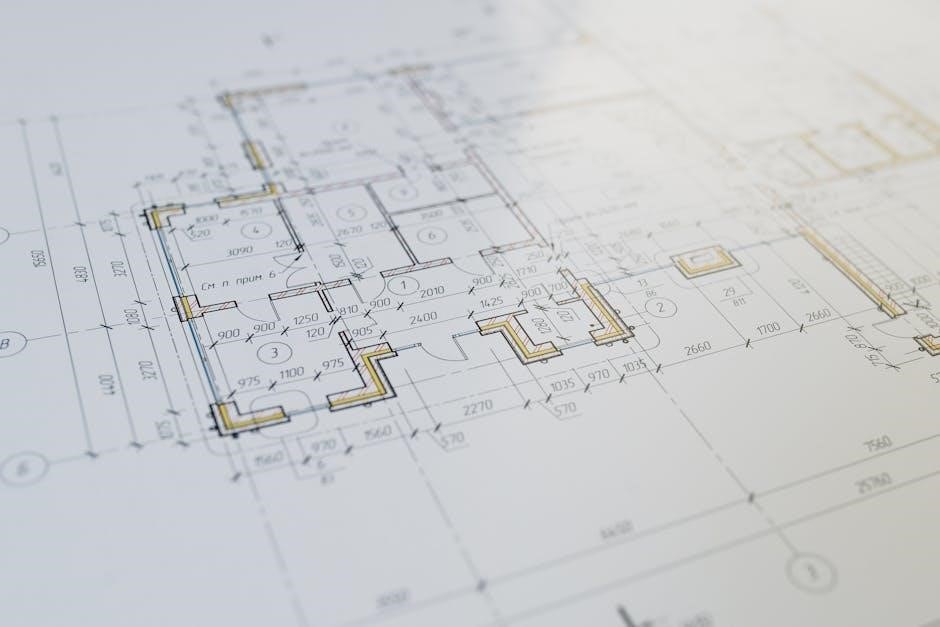
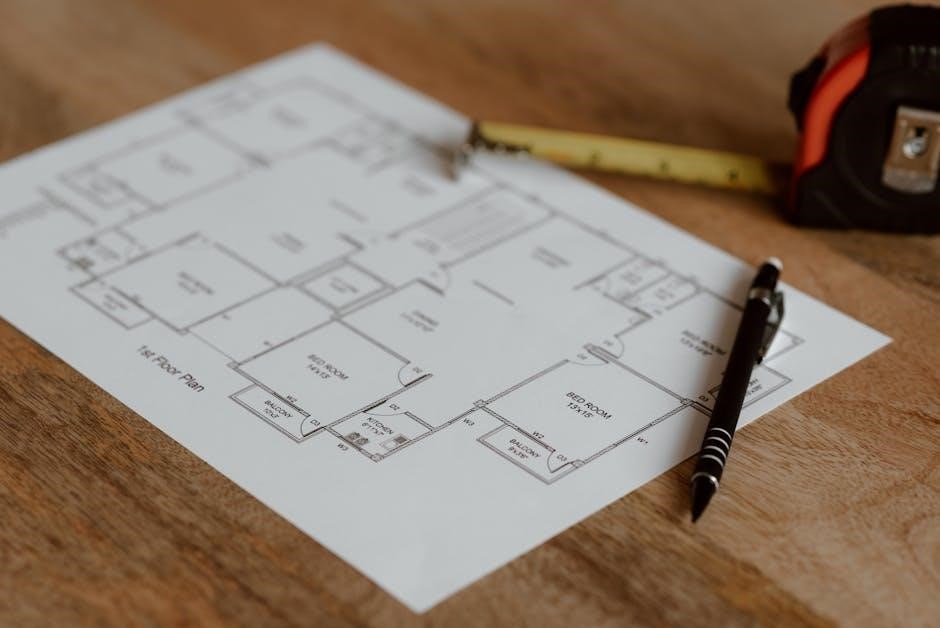
Architectural plans are frequently featured, asking students to determine actual room dimensions from a blueprint. These PDF resources often present problems related to building models, requiring students to reduce object sizes proportionally.
Engineering applications appear, such as calculating the size of a component based on a scaled design.
Landscape architecture is also represented, with problems involving garden layouts and proportional scaling. These worksheets aim to demonstrate the relevance of scale drawings in various professions.

Creating Scale Drawings
Scale drawing worksheets for 7th grade often require students to construct drawings themselves, choosing appropriate scales and ensuring accurate proportional representation.
Choosing an Appropriate Scale
Selecting the right scale is crucial when completing a 7th-grade scale drawing worksheet. Students must consider the size of the actual object and the available space on their paper. A PDF worksheet might present scenarios requiring different scales for clarity.
For instance, mapping a room necessitates a different scale than depicting a city block. The chosen scale should result in a drawing that’s neither too large to fit nor too small to accurately measure.
Worksheets often guide students through this process, prompting them to calculate and compare potential scales. Understanding unit conversions is also vital; ensuring consistency between actual measurements and drawing measurements is key to success.
Drawing to Scale Accurately
Accuracy is paramount when completing a 7th-grade scale drawing worksheet, often delivered as a PDF. Students must meticulously translate calculated measurements onto their drawings, utilizing rulers and protractors with precision.
Careful attention to detail prevents distortions and ensures the drawing faithfully represents the actual object. Worksheets frequently include grid paper to aid in accurate scaling and alignment.
Consistent use of the chosen scale factor throughout the drawing is essential. Students should double-check their work, comparing drawing dimensions to calculated values. Mastering this skill builds a strong foundation for geometric understanding and spatial reasoning.

Advanced Scale Drawing Concepts
PDF worksheets for 7th grade extend to drawings with varied units and irregular shapes, challenging students with complex scale applications.
Scale Drawings with Different Units
Scale drawing worksheets for 7th grade frequently introduce the complexity of differing units – inches to feet, meters to kilometers, or miles to inches. These PDF resources require students to convert measurements before applying the scale factor.
For example, a map might use a scale of 1 cm = 10 km, while a problem asks for the distance in meters. Students must first convert kilometers to meters. These worksheets emphasize unit conversion skills alongside proportional reasoning.
Many PDF practice sheets include problems where students must determine the actual length of an object when the drawing uses one unit and the answer needs to be in another. This reinforces a deeper understanding of scale and measurement.
Working with Irregular Shapes
Scale drawing worksheets for 7th grade often move beyond simple rectangles and squares to include irregular shapes. These PDF resources challenge students to apply scale factors to figures with curves and varying side lengths.
Calculating perimeter and area becomes more complex with irregular shapes. Students must carefully measure each side of the scaled drawing and then multiply by the scale factor to find the corresponding actual dimensions.
Some worksheets provide grid paper to aid in accurate measurement of irregular shapes. Others require students to estimate measurements, fostering practical skills. These PDF exercises build spatial reasoning and problem-solving abilities.
Resources and Practice
Numerous free scale drawing worksheets in PDF format are available online for 7th grade students, alongside interactive tools for enhanced practice!
Free Printable Scale Drawing Worksheets (PDF)
PDF scale drawing worksheets for 7th grade are readily accessible online, offering convenient practice for students. Cuemath provides free downloadable math worksheets focused on scale and proportion skills. These resources often include problems requiring students to calculate actual distances from drawings and vice versa.
Many worksheets focus on real-world applications, such as interpreting maps or creating scaled representations of objects. Blizzard Bag assignments also utilize scale drawing problems, reinforcing the concept through practical exercises. These printable materials are designed to help students master the skill of using scale factors to determine missing measures.
Teachers and parents can easily download and print these worksheets for in-class activities or homework assignments, supporting student learning and skill development.
Online Scale Drawing Tools
While printable PDF worksheets are valuable, several online tools enhance the learning experience of scale drawings for 7th grade students. Interactive platforms allow students to dynamically manipulate scale factors and observe the resulting changes in dimensions. These tools often provide immediate feedback, aiding in comprehension and error correction.
Some platforms offer virtual rulers and grids, enabling students to practice drawing to scale accurately. These digital environments can be particularly helpful for visualizing the relationship between the drawing and the actual object. Online resources complement traditional worksheets, offering a more engaging and interactive way to practice scale calculations.
Exploring these tools can solidify understanding and build confidence in applying scale drawing concepts.
Answer Keys and Solutions
When utilizing 7th grade scale drawing worksheets in PDF format, access to answer keys and detailed solutions is crucial for effective learning and self-assessment. Many online resources providing these worksheets also offer corresponding answer keys, allowing students to check their work independently.
Detailed solutions, often available for more complex problems, demonstrate the step-by-step process of applying scale factors and proportions. This helps students understand how to arrive at the correct answer, not just what the answer is.
Reviewing solutions clarifies common errors and reinforces the underlying concepts of scale drawings, promoting a deeper understanding of the material.

Troubleshooting Common Errors
Scale drawing worksheets often cause confusion with unit conversions and misunderstanding scale factors. Careful attention to detail and practice are key!
Misunderstanding Scale Factor
Scale factor confusion is a frequent issue when students tackle 7th-grade scale drawing worksheets. Many students struggle to grasp that the scale factor isn’t the actual size, but a ratio representing the proportional relationship between the drawing and reality.
A common error involves incorrectly applying the scale factor during calculations. For example, if a map’s scale is 1 inch = 50 miles, students might add 50 miles for each inch instead of multiplying.
PDF worksheets often present problems requiring students to determine the scale factor given actual measurements and drawing dimensions, which can be particularly challenging. Reinforcing the concept through visual aids and repeated practice is crucial for mastery.
Incorrect Unit Conversions
Incorrect unit conversions frequently plague students completing 7th-grade scale drawing worksheets, especially those involving PDF-based practice. Problems often present measurements in mixed units – inches on the drawing and miles in reality – demanding conversion skills.
A typical mistake is forgetting to convert all measurements to the same unit before applying the scale factor. For instance, a student might attempt to calculate using inches and miles simultaneously, leading to an inaccurate result.
Worksheets often require converting between feet, yards, miles, and centimeters, necessitating a strong understanding of these relationships. Careful attention to units and consistent conversion are vital for success.